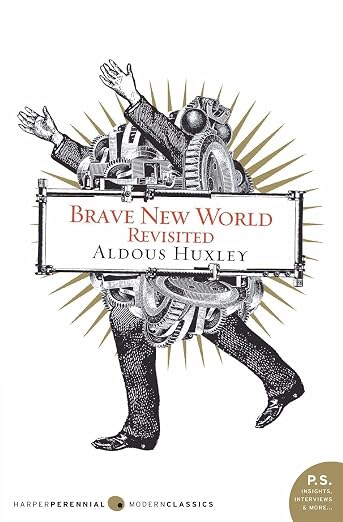
Brave New World Revisited
Aldous Huxley
1958
A nonfiction examination of propaganda, conditioning, persuasion, and the forces shaping human behaviour
Published in 1958, Brave New World Revisited returns to the concerns Huxley explored fictionally in Brave New World, published twenty-six years earlier. Rather than constructing another imagined society, Huxley examines the world around him and considers whether developments in psychology, propaganda, advertising, population growth, education, and political organisation were beginning to resemble some of the mechanisms he had explored in the novel.
The distinction between the two works is important. Brave New World presents a fictional society in which human beings have been deliberately conditioned to fit a technological and social order. Brave New World Revisited steps outside that fictional world and asks how real societies influence people without necessarily appearing to do so.
Huxley examines the ways information can be managed, attention captured, desires cultivated, and beliefs shaped. His concern is not limited to governments or overt political propaganda. Commercial advertising, mass communication, psychological techniques, and the increasing ability to influence individuals at scale all become part of the question.
The result is not simply an explanation of Brave New World. It is Huxley’s attempt to reconsider his own earlier work in light of the world that had developed since its publication.
For DCRU, this makes Brave New World Revisited particularly valuable. It provides a rare opportunity to examine an author returning to his own speculative work and asking whether the mechanisms imagined as fiction are beginning to appear in reality. It also gives us another question to ask today: which parts of Huxley’s analysis remain useful, which have aged poorly, and which mechanisms have evolved into forms he could not have anticipated?
Read alongside Brave New World, the two works from a useful pair. The novel gives us the imagined system. Revisited examines the forces that might make aspects of such a system possible.
The distance between the two books is where much of the interesting work begins