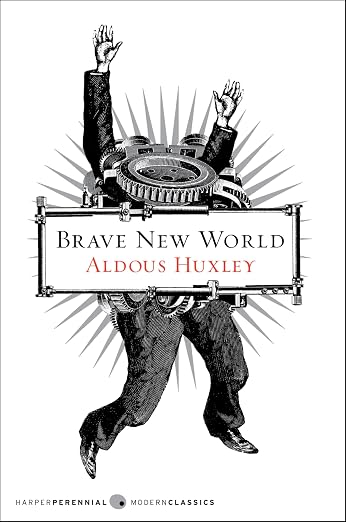
Brave New World
Aldous Huxley
1932
A dystopian novel about technology, conditioning, consumption, and the manufacture of social stability.
Published in 1932, Brave New World imagines a future society in which human reproduction, education, consumption, entertainment, and social organisation have been absorbed into a single technological system. The World State has largely eliminated war, poverty, instability, and many of the forms of suffering associated with ordinary human life. It has done so by producing citizens who have been conditioned from birth to accept their place within the system.
The society Huxley imagines is not maintained primarily through force. Its stability depends upon conditioning, distraction, consumption, pleasure, and the careful management of desire. People are encouraged to want what the system requires them to want, making social control less a matter of coercion than of shaping the conditions under which people form their preferences in the first place.
This makes Brave New World particularly relevant to the study of technology and human behaviour. Huxley’s concern is not simply that technology might become powerful. It is that technological capability, when combined with social organisation and behavioural conditioning, can change the kinds of lives people consider desirable.
What happens when convenience becomes more valuable than freedom? What happens when discomfort is treated as a problem to be eliminated rather than an unavoidable part of human experience? And what happens then a system no longer needs to suppress dissent because it has learned to make dissent undesirable?
More than two decades after the novel’s publication, Huxley returned to these questions in Brave New World Revisited (1958), a work of nonfiction examining propaganda, advertising, psychological conditioning, population growth, and other forces that he believed could move real societies toward some of the conditions imagined in the novel. See also: Brave New World Revisited.
The value of Brave New World is not found in treating it as a prediction that come true. Its value lies in the questions it continues to raise about the relationship between technological system, social order, human desire, and autonomy.
What if the most effective system of control is one that people experience as freedom?
Read as fiction. Examine it as a question.