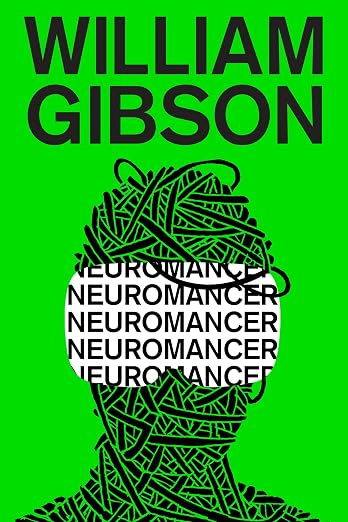
Neuromancer
William Gibson
1984
A science-fiction novel about cyberspace, artificial intelligence, hacking, corporate power, and life inside a networked technological world
Published in 1984, Neuromancer follows Case, a washed-up computer hacker living in a technologically saturated future where information, capital, corporations, artificial intelligence, and human bodies are deeply entangled. Recruited for one final job, Case is drawn into a world of hackers, mercenaries, powerful corporations, artificial intelligences, and the vast virtual environment Gibson calls cyberspace.
The novel is often described as having predicted the Internet, but that description misses much of what makes it interesting. Gibson was not simply imagining faster computers or future communications networks. He was imagining what might happen when networked computation become part of the environment in which people live, work, communicate, make money, form identities, and exercise power.
Cyberspace in Neuromancer is therefore more than a technological invention. It is a cultural space. Information has become something that can be entered, navigated, stolen, traded, protected, and fought over. Corporations operate across borders, personal identity becomes increasingly unstable, and the distinction between the physical and digital worlds begins to lose its importance.
The novel also presents technology as something inseparable from power. Its characters do not simply use machines; they exist within systems of corporations, networks, markets, artificial intelligence, surveillance, and technological dependence. Access to information becomes a form of power, while those who can navigate these systems occupy a different position from those who cannot.
This is one of the reasons Neuromancer remains relevant to the study of digital culture. Long before the web become a part of everyday life, Gibson was asking what happens when information becomes an environment, when identity becomes partly mediated by networks, and when technological systems become places in which culture itself develops.
For DCRU, the interesting question is not whether Gibson accurately predicted the technologies that would eventually appear. Many details of the future he imagined did not come to pass, while others arrived in forms, he could not have anticipated.
The more enduring question is what kind of culture emerges when humans become deeply embedded in their own technological networks.
What happens when the network is no longer something we connect to, but somewhere we live?
Neuromancer is included in the DCRU library as an important work of cyberpunk fiction and as and early exploration of the cultural consequences of networked technology, artificial intelligence, digital identity, and information as a form of power.
Neuromancer is the first book in Gibson’s Sprawl trilogy, followed by Count Zero (1986) and Mona Lisa Overdrive (1988). The three novels share a setting and expand many of the themes introduced here, but Neuromancer stands on its own as the starting point for Gibson’s vision of a networked technological culture.